HSM Announces Season Calendar

The Historical Society of the Town of Middletown (HSM) is gearing up for a busy season of programs, projects and a major exhibit on the Civil War.

The first program of 2013 will be held Saturday, April 20 at 10 a.m. at the HSM Hall, 778 Cemetery Road, Margaretville when homeowners in Margaretville and Halcottsville share the secrets of their houses and the people who lived there.

Andrew Goldberg will share what he’s uncovered about the Bragg Hollow farmhouse he recently purchased, and Connie and Tom Jeffers will describe the backstory of their beautifully restored Victorian in Margaretville.

Friends of Middletown Cemeteries will gather Monday, April 22 at 6 p.m. at the hall to discuss several possible cemetery restoration projects. All cemetery lovers are welcome.

The Second Annual Postcard and Ephemera Show and Sale is scheduled for June 8 at the hall, 10-3. Several vendors will have vintage materials on display and will make brief presentations.

Plans are speeding along for the Second Annual Living History Cemetery Tour, to be held June 29 in Clovesville, near the Village of Fleischmanns. Ten former residents will be profiled, including a 10-year-old girl, the last of the stage coach drivers, and famed bear hunter Mike Todd! Stay tuned for an announcement of the cast for this ambitious event, which was hugely popular last year when it debuted.

The local face of the Civil War will be presented at a summer-long exhibit which will open July 4 and will be available for viewing every Saturday from July 6 through September 1 from 11 to 2. Photos, artifacts, and individual information sheets on more than 300 Middletown area soldiers who served the Union will be featured. The Delaware County Historical Association will loan portions of its exhibit, “Delaware County in the Civil War,” for this observance of the War’s sesquicentennial.

HSM is still seeking photographs, letters and information about local Civil War veterans and their families for this exhibit. Please email history@catskill.net, or call 845-586-4973 if you have family history to share.

Five outstanding Civil War programs are scheduled throughout the summer to complement the exhibit, from battlefield medicine and horses in combat (July 13), to women’s roles and wardrobe of the 1860s (August 10). Historian Frank Waterman will explain how and why men found themselves in uniform on July 25, and Open Eye Theater and the Delaware Dulcimores will collaborate with HSM to produce a moving reading from local Civil War letters and diaries on August 22.

A community picnic on Sunday of Labor Day weekend will bring summer and the exhibit to an end with the music of the 77th Regimental Balladeers.

HSM will also participate in activities and special events that will mark the 250th anniversary of the arrival of the first white settlers in Middletown. The Village of Fleischmanns is also celebrating a milestone this year – the 100th anniversary of its incorporation as a village.
 

Barns take a bow at Cauliflower Fest

Barns take a bow at Cauliflower Fest

Ever wonder what stories your old house could tell if its walls could talk?

The Historical Society of the Town of Middletown (HSM) will host a program Saturday, April 20 by two local homeowners who will recount the history of their homes and will try to give voice to some of the people who lived there.

“House History Hunting,” the first HSM program of 2013, will begin at10 a.m. at the Society’s Hall, 778 Cemetery Road, Margaretville. Admission is $2 for members, $4 for all others.

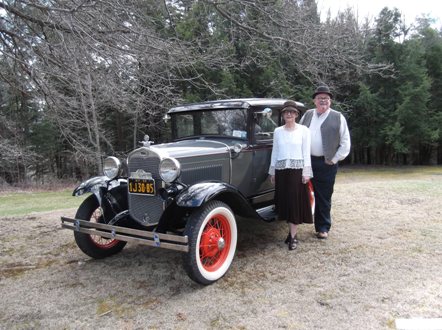
Tom and Connie Jeffers in character

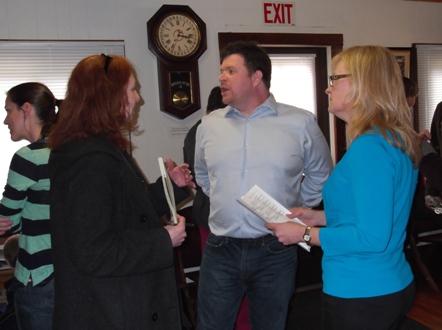
Andrew Goldberg with audience members

Andrew Goldberg of Halcottsville and Connie and Tom Jeffers of Margaretville will tell what they’ve uncovered about their houses, sharing the sources they used to peel back the layers of time to reveal who built them, who occupied them, and how the buildings were altered over generations.

Goldberg and his wife, Leslie Derkash, purchased their Gothic revival house in Bragg Hollow one year ago “after searching for a farmhouse that retained a lot of its original details.” The house was built in 1869 by carpenter George W. Hubbell for Orrin Hewitt on what is reputedly the oldest farm in Bragg Hollow, first settled by Seth Parker in 1801. Today the property includes 19 acres and the remnants of a stone barn ramp.

Drama permeates the unassuming wood frame house, and the Goldbergs will reveal the surprising details, describing their search through deeds, local history volumes, genealogy records, newspaper accounts and physical evidence.

Connie and Tom Jeffers will also describe the backstory of their beautifully restored Queen Anne Victorian in Margaretville.

At the end of September in 1892, architect, contractor and builder Henry Coulter and his wife Nina purchased a lot on the northwest end of Walnut Street from Jeremiah Ackerly. They built a house in which to raise their family and it was completed in the mid-1890s.

Since Mr. Coulter was a builder and the home was intended for his family to live in, the construction is amazingly sound “and somewhat over-built,” the Jeffers say. The house features a typical wraparound front porch with turret. A carriage house is in back.

Previous owners (there have been seven) added a massive modern kitchen and a master suite in what was a third floor attic, including the raising the turret and witches cap by 14 feet.


Season preview!

It’s just starting to feel like spring but we’ve been busy firming up plans for a jam-packed season of programs and activities.

Details will follow on this website, and in a flyer to be sent with the Spring Bridge to our members. For now, a partial preview:

The first program of the year will be April 20 when homeowners in Margaretville and Halcottsville share the secrets of their houses and the people who lived there.

Vintage postcards and ephemera will be offered at a show and sale at the hall June 8.

The second annual Living History Cemetery Tour will be June 29 in Clovesville. Ten former residents will be profiled, including a 10-year-old girl, the last of the stage coach drivers, and famed bear hunter Mike Todd!

Come see local faces of the Civil War at our summer exhibit July 4-Sept. 1. The hall will be open every Saturday. Five outstanding Civil War programs are scheduled throughout the summer, from battlefield medicine, to women’s roles and a reading from local letters and diaries. A horse named Rebel will tell his story on July 13.

Mark your calendars for a community picnic Sunday of Labor Day weekend, with the music of the 77th Regimental Balladeers.

We’ll have the History Tent at the Cauliflower Festival Sept. 29. The event will feature a sheep and wool exhibit and demos this year!

Entertaining speaker “Big Chuck” D’Imperio will talk about “Fascinating Facts of the Empire State” at our Annual Meeting Oct. 27.

Want to volunteer at any of these events? Email us! We could use your help!

The Stone family saga

This is the tale of a Clovesville family whose name has faded from the Catskills because the men who carried it left to find their fortunes and meet their destinies more than 130 years ago.

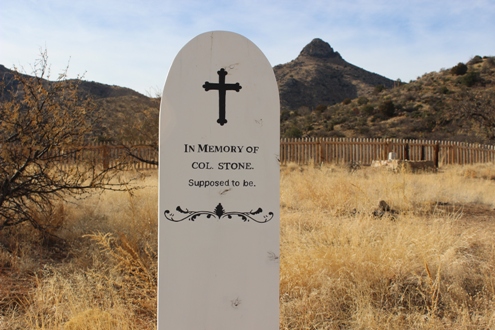
Clovesville native John Stone’s burial place in Arizona. The “Col.” title was honorary, and the term “supposed to be” shows some uncertainly about his remains, which were reburied here a year after his death at Apache hands in 1869.

They were the Stones: John, William, George and Rutson, sons of Caroline and Robert. Their father died in 1849 at the age of 47, leaving a 40 year old wife and 9 children, from infant twins, Rutson and Jutson, to eldest son Augustus, 19. Caroline apparently maintained a store to support the family, which was scattered at the coming of the Civil War.

John Finkle Stone was 21 when he enlisted as a musician in the Regular Army’s 5th Infantry in 1857. He was sent to Washington Territory, then New Mexico Territory where he spent most of the war years, before being posted to Kansas, mustering out in 1867. Some sources say that after his discharge he became U.S. Marshall and was later appointed Collector of Customs for the District of El Paso Del Norte and relocated to Tucson, Arizona. He helped organize the Apache Pass Mining Company in 1868 to develop the Harris Lode Gold Mining District near Fort Bowie. On October 5, 1869, he boarded a stage for Tucson with a driver and a four-soldier escort. All were killed that day in an Apache ambush near Dragoon Springs. His body rests in the cemetery at Fort Bowie, a National Historic Site.

William Henry Stone joined the Army as captain of Company G of the 144th New York Volunteer Regiment. Born in 1841, he was just 21 when he led the Middletown-raised company off to war in September of 1862. A little more than a year later, he succumbed to chronic dysentery contracted in camp. He had managed to get home to his mother, who we can assume nursed him until he passed away October 17, 1863. He is buried in the Clovesville Cemetery.

William’s younger brother George saw active duty after enlisting in the 14th Cavalry in June of 1863. Seven months later, he was captured at the Battle of Mansfield, Louisiana during the Red River campaign, and spent six months interred in the Confederate prison, Camp Ford in Tyler, Texas, until the following November, when he was exchanged. In the same month he was appointed a captain in the 18th New York Cavalry, became ordnance officer of the Department of the Gulf, and commanded the San Antonio arsenal from September, 1865 until June 1866 when he was mustered out of service. After the war George Stone was a civil engineer on the Union Pacific Railroad until its completion in 1869. The following year he went to California, and worked on a number of railroads as superintendent or contractor. In 1901, he organized the Pacific Portland Cement Company, and had a comfortable life with wife Annie Burr Jennings, and their three daughters. He was California state chairman of the Republican party, and prominent in San Francisco, where he died in 1915.

Rutson Stone was born Oct. 21, 1848 in Clovesville. His twin, Jutson, evidently died as an infant. Rutson was left at home to be with his mother as one by one, all his siblings departed or married. The 1870 Middletown census said he worked in a print shop. He was 21, his mother was 61. In 1878 she died, leaving Rutson free to roam. He followed big brother George to California, where he was a surveyor in San Francisco in 1880, a clerk in 1888, and a “papermaker” in Lynwood in 1890. He and wife Annie had two daughters and a son, Robert, who does not appear to have survived to adulthood.

We don’t know what happened to her eldest son Augustus, but between 1849 and her own death in 1878, Caroline endured the loss of her husband and five other boys – one an infant, one in the Civil War, one to Indian attack and two more to the siren song of California. Unless Augustus raised a family somewhere, there were no boys to carry on Robert Stone’s name, though his daughters married local men and left descendants who remain in these parts today.

You can learn more about this family at the Living History Cemetery Tour of the Clovesville Cemetery June 29 when Caroline will be portrayed, and at the Historical Society of Middletown’s Civil War exhibit at the HSM Hall July 4-August 31, where John, William and George Stone will be profiled.

A new pair of boots — a shop local story

A new pair of boots — a shop local story

In researching the lives of Middletown’s Civil War veterans, I came across an interesting letter to the Catskill Mountain News published April 8, 1960. B. C. Todd wrote in to share memories and stories that old-timers had passed on to him, including this one about Calvin Crosby, a Clovesville merchant and tanner (and Civil War vet) who enjoyed almost instant gratification when he went looking for a new pair of boots. DG

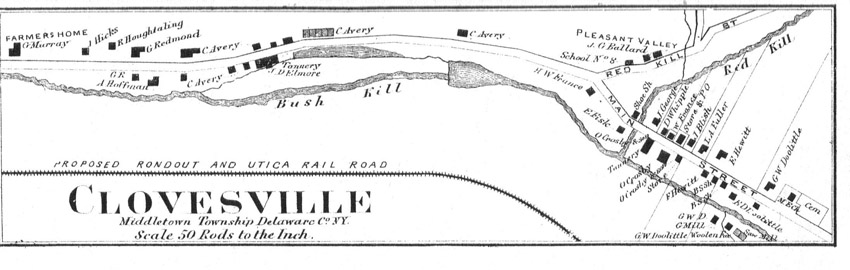
Clovesville, from the Beers 1869 Atlas of Delaware County. Note the tannery, house and store of Orrace Crosby and son Calvin along Main Street to the right of Red Kill stream, and the shoe shop, presumably Mr. VanBramer’s, across the street, to the left of the stream.

In researching the lives of Middletown’s Civil War veterans, I came across an interesting letter to the Catskill Mountain News published April 8, 1960. B. C. Todd wrote in to share memories and stories that old-timers had passed on to him, including this one about Calvin Crosby, a Clovesville merchant and tanner (and Civil War vet) who enjoyed almost instant gratification when he went looking for a new pair of boots. DG

“Thinking of my leather boots with red tops recalls a true story which I often heard father and others tell. For many years, before shoes could be purchased in stores, men wore for dress-up what were called “fine boots.” These were made from light, soft calf skins. In Griffin Comers there was, during this period and afterwards, a boot and shoe maker, one Jacob VanBramer. He was considered to be a craftsman at his trade. There was a Calvin Crosby who operated a grocery store where the home of the late John Curtis now stands. Mr. Crosby at one time owned and operated the tannery located on the present Jimmy Pavlos property below Clovesville , . . This farm was spoken of for years and years as the “Tannery farm.”

Mr. Crosby had occasion to go to Kingston on business. He discovered that his fine boots were not fit for further use. He went to VanBramer’s shop and asked if he had fine boots on hand that would fit. Mr. VanBramer replied that he did not, but said “if you have a couple of good calf skins at the tannery and will bring them, I will make you a pair of boots.” Mr. Crosby said he needed them by the time the stage came along about daylight next moming. Mr. VanBramer repeated that he could make a pair of boots and have them ready saying that he would leave them outside his shop door before daylight. This was in the early evening. Mr. Crosby said, “Man, you can’t possibly do that. I tell you I must have them to wear on the stage in the morning.”

However, Mr. Crosby went to the tannery and brought the calf skins. Before daylight the next morning, he found the boots setting outside the door, ready to pull on.”