Those Indian caves

Those Indian caves

From time to time, tales have been told about ‘Indian caves’ in our area, rock shelters where Native Americans reputedly stayed while traveling through on seasonal hunting and fishing expeditions (see the Our Town page of the Communities section on this website for a bit about the first occupants of the East Branch Valley.)

Mike Kudish at another sheltering overhang

David Rubenstein in Arkville ‘Indian’ cave

David Rubenstein, a student of Native cultures of the Northeast, wanted to know if the Historical Society had ever ascertained the location of any of these caves. Had artifacts or petroglyphs been discovered? Where was the “ancient village of Pakatakan” (spelled many different ways), as mentioned in Ethel Bussy’s History and Stories of Margaretville and the Surrounding Area?

A search of the Catskill Mountain News turned up a 1934 article that an Arkville cave had in fact yielded stone implements and arrow points for many years. The article said Roxbury lawyer Ralph Ives and sons Charles and Ralph Jr. unearthed a fire pit in this cave containing broken pottery, flint scrapers, a hammerstone, pestle, stone sinkers and other implements, along with animal bones made into needles and awls. Ives, who exhibited some of the items at a meeting of the Oneonta Kiwanis Club in June of 1934, claimed the material to be of Algonquin origin, perhaps dating back 2,500 years.

This type of activity is prohibited today, out of respect for the people who left behind traces of their lives, and of the stories they could tell us if left in place. Does anyone know where these artifacts may have landed?

Using information from the article, David Rubenstein, forest historian Michael Kudish and I went to have a look at the cave in early May, but we found nothing to indicate prehistoric occupation. The cave (actually an overhanging rock ledge) is spacious, but not the 30x20x8-foot high cave described in the newspaper account. Big enough to keep modern day hunters and woodwalkers out of the elements though, and clearly a few have taken advantage of that.

We checked out two other likely “Indian caves” and the surrounding forest. Dr. Kudish thinks the combination of tree species – white oak, mountain laurel, black birch, American chestnut and others, indicate the probability of repeated burns, suggesting that Indians may have found shelter in southeast-facing caves and cleared some of the prime flood plain land to grow summer crops.

Intriguing. We’ll likely never know for certain. But as woods walker and writer Peter Manning wrote following a recent tramp with Bovina historian Ray LaFever to “Indian Rocks” in that town, “It’s good to have timeless places that set our imaginations at play.”

If you have a similar story or would like to respond to this one, let us hear from you.

Diane Galusha

History Hike

Hikers, nature lovers and history buffs are invited to tramp to the summit of Balsam Lake Mountain Saturday, May 14 in an outing sponsored by the Historical Society of the Town of Middletown (HSM).

Laurie Rankin, volunteer coordinator at the Balsam Lake Mountain Fire Tower, and her husband, Tom will offer a tour of the tower and the observer’s cabin and will discuss the history of the tower, which was used to spot forest fires in the surrounding Catskills for 100 years.

In the event of heavy or steady rain, the hike will be held Sunday, May 15. The group will set off promptly at 10 a.m. and expects to return at 3 p.m.

This is a moderately difficult, six mile round-trip hike to the 3,723-foot summit in the Town of Hardenburg. Participants are advised to bring a lunch, appropriate footwear and layered dress and to meet at the trailhead parking area on Millbrook Rd. Take Dry Brook Rd. off Rte 28, Arkville six miles, turn right on Millbrook Rd., and go 2.3 miles to the trailhead.

This event is free for HSM members, $2 for all others. Pre-registration is not necessary. For more information or weather questions, call 845-586-4973.

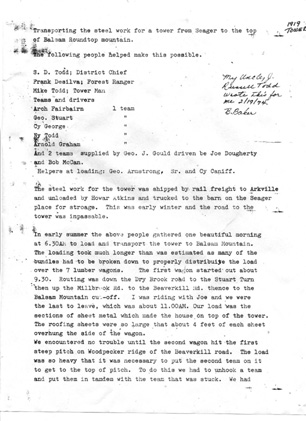
A log tower was originally built on the mountain in 1887 by members of the Balsam Lake Club to protect its hunting and fishing lands. Fire tower historian Marty Podskoch says that when that tower burned, a second was built on the site in 1901. It was later taken over by the State and replaced with the current steel tower. A cabin for the observer was built by the Conservation Department in 1919; and was rebuilt in 1931.

Laurie Baker Rankin spent a lot of time on the mountain as a child, because her father, Larry Baker, was the last full time observer there, serving from 1958 to 1972. Other observers included Edward Avery, the legendary Mike Todd and Gus Stewart. Ken Kittle and Tim Hinkley also manned the tower before the DEC discontinued its use in 1988.

In the 1990s, the Catskill Center for Conservation and Development and the DEC reached an agreement to refurbish five fire towers in the Catskills and to have volunteers man them as observers once did. A tremendous local volunteer effort was successfully accomplished in 2000.

Please join us for a look at the current state of the tower and cabin. The rich history of both, some artifacts, some delightful memories, some hiker education and we hope fabulous views await all!

More information on the towers can be found at www.catskillcenter.org/towers.

For information on HSM events and activities, please visit www.mtownhistory.org.

The News, from 1863

Orson Allaben was an educated, principled and influential man. A man with character. Money. And opinions. An early developer of the Village of Margaretville, he was a doctor, a businessman, and, in the 1860s, started a newspaper called The Utilitarian, “A Family Journal, Devoted to the Fireside, the Field and the Town.” The two remaining copies of the newspaper, in the collection of the Delaware County Historical Association in Delhi, show it was also useful in promoting his political philosophy. He was not a fan of Abraham Lincoln, or a supporter of the Civil War. In the issue of September 10, 1863, he put forth an “Apology” that the lengthy list of Army draftees “who have won prizes in the great National Lottery of Messrs. Lincoln, Greely & Co.” took up a page of his four-page newspaper and bumped his “Departments of Political Economy, War News and Editorials” that week. “To some, it will be interesting to learn the names of friends or relatives who have been so unlucky. To those of our patrons the list does not interest, we will pray them to excuse.”

The draft list appeared in numerous other newspapers, including the Bloomville Mirror, which Linda Ogborn transcribed for the Delaware County History and Genealogy website. There were “334 names in the wheel” for the Middletown draft, and 95 names were drawn.

Also in the Utilitarian that week, attorney DeWitt Griffin of Griffins Corners (Fleischmanns) advertised that he was ready to help secure “Bounty, Back Pay and Pensions for Soldiers”; Jonathan Keator of Clark’s Factory (Dunraven) requested the owner of a “large, light red (stray) cow, about ten years old, with a white bag” to come claim her; and David Ackerley, proprietor of the Ackerley House in Margaretville, proclaimed his establishment to be “favorably located for trout fishing in the lakes and streams of Dry Brook, Hardenburgh and Beaverkill,” and to be served by regular mail and stage lines, leaving daily for Delhi and Kingston, tri-weekly for Moresville (Grand Gorge), and twice a week for Colchester and New Kingston.”

We’ll have more from the Utilitarian from time to time.

Winter into Spring

As the new season struggles to overcome the old, it’s worth remembering that ‘twas ever thus. Evidence of this can be found in the diaries of James Thomson, a New Kingston farmer who kept track of his family’s activities from 1838 to 1903, a remarkable 65 years, with only a few lapses. The original diaries are in the New York State Historical Association archives in Cooperstown, but George Hendricks photocopied some of the transcribed diaries, and has shared them with HSM.

Here are some entries from late winter, 1839:

March 9, Saturday.
I drawed some wood. Father, Andrew and John (James’ brothers) have made some Sap troughs (in the days before wooden buckets were commonly made by coopers to catch sap from the maples, farmers would make collection troughs of poplar or ash.)

March 10. Sabbath.
It froze very hard last night and was very cold through the day.

March 12.
Was a fine warm day. We have been getting out flax and Andrew has made a sap neck yoke.

March 18.
Has been warm with some rain, we have split rails. We have been up to the sugar Camp with troughs. 

March 20.
Cloudy with sleet and rain. John and father have been cutting wood at the camp.

March 23.
Was a cool day, we built a arch (stone fireplace) for the sap boilers. The sap ran very fast in the afternoon.

March 25.
The ground was white with snow and it did not melt all day. We have been drawing wood with both teames.

March 26.
A fine day, but cool. We cleaned flax in the forenoon, and in the afternoon we tap(p)ed (maple trees)

March 27,
Clear and warm, we tap(p)ed the rest of the Camp and boiled considerabel of Sap.


March 28.
Very warm, I made some Sap troughs and tap(p)ed 16 more trees and built some wall.

March 29 I have been building wall. John has been boiling sap.

March 30
Clear and frosty

April,
the first Month of Spring

April 1
Monday was a very warm day. We have got 125 pails of Sap.

April 2.
We carried 54 pails of Sap in the morning.

April 4.
Very warm and clear. We got 30 pails of Sap. Father has been to the mill and Andrew and me have been drawing stones. 

April 5.
The snow is I believe all in view gone. I have put off my woolen shirt and my fingers are very sore with handling stones.

April 7.
Very warm in the morning, it rained a little and the wind changed to the north and became cold.

April 8.
Cold in the morning, but the sun shone pleasant. I have begun to plow.

Because it was difficult to store maple syrup, farm families boiled it past the syrup stage, into sugar. James does not mention how much maple sugar was made in 1839, but the following year, on March 4, he wrote “Very warm all day. They sugared off 33 pounds of sugar.”