Excerpts of an address delivered s at the 22nd Annual Meeting of the Historical Society of the Town of Middletown, Nov. 7, 2026
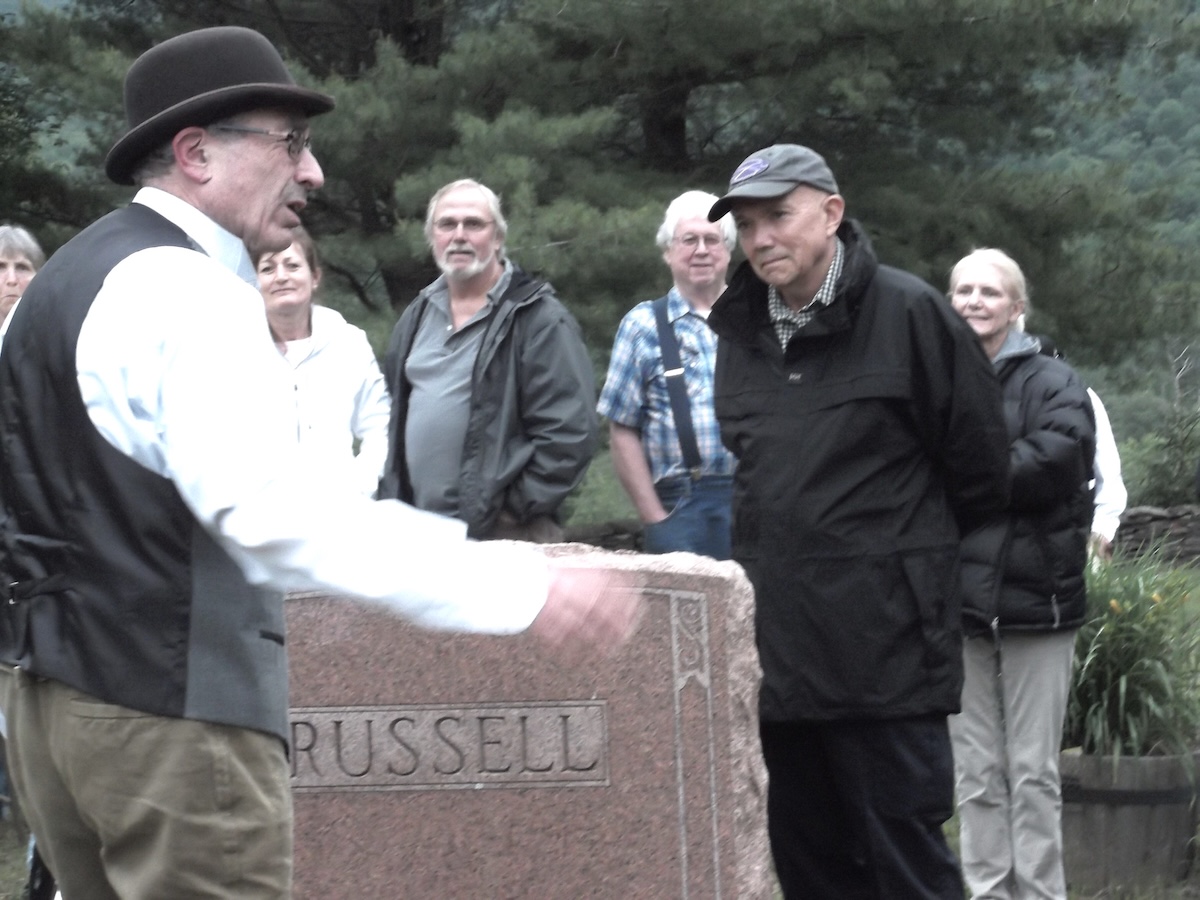
Bill Birns portrayed Andrew Russell at the Living History Tour of New Kingston Valley Cemetery in 2015.
I was introduced to Margaretville by my college roommate, Pete Palen, who grew up here. Every week, Pete would receive in the mail a copy of the Catskill Mountain News. This was in the days when the weekly newspaper’s stock in trade was the “Local and Personal” columns, one for each hamlet and village. We sophomore sophisticates would howl at journalistic reports that “Miss Gertrude Klapper, Miss Marian Connell, and Miss Doris Gavette drove to Schoharie Thursday last where they dined on prime rib at The Parrot House.”
But the howls turned to curiosity and interest, one day, when Pete tried to tell me a story about a highway accident. “My father’s best friend is a truck driver,” he began “and…”I cut him off at and.
“Your father’s best friend is a what?” I asked, my face contorted with incredulity.
“A truck driver. Why? I’m trying to tell you a story.”
“Pete,” I demanded, “Your father is a doctor and his best friend is a truck driver?”
“Yeah. Why?”
“I gotta see this place,” I said. In New Rochelle, doctors and truck drivers did not hang out.
I drove upstate to see the place one Sunday in the summer between my sophomore and junior years. My brothers had graduated and moved on, mother was away on a once-in-a-lifetime trip to Ireland, and I’d had an argument with my girlfriend. I’m gonna go to Margaretville, see Pete.
When I arrived in town and found Dr. & Mrs. Palen’s home, they greeted me at the front door. “Pete’s in Downsville playing Town Team baseball, Bill, but come with us,” they said.
Town team baseball? Where am I? Town Team baseball is pretty cool.
“Yes, Bill, please. Come with us. We’re going to a wedding.”
Going to a wedding? Oz. This place is Oz.
We went. The wedding was at the Arkville Pavilion. Glenn Mills’ three-piece country band played.
There I met Pete’s uncles Frank and Bob Russell, who later became my neighbors and friends. Frank, Uncle of the bride, was dressed to his nines, wearing a late 1940s double-breasted suit, hand-painted tie and high-top Converse All-stars. Edie Davidson, school nurse, became my best friend as the band played on.
They had me. These mountain people, so authentically and unapologetically themselves. The openness to a stranger, me, as if I were part of the gang, and always had been. Wow. I did not know what Catskill Mountain Culture was, or even that, possibly, it’s a thing, but I wanted to know about this place, these people, wanted to understand what made this way of living and being tick.
This Here was so different from that there, the place where I grew up.
For the past 19 years, everything I have written has been an attempt to analyze, explain, narrate, interpret and, most importantly, to celebrate that Mountain Culture.
And that is the importance and value of Local History. We use memory and story and primary sources, documents, such as those stored here, in our local archive, to help us reconstruct the lives and values of the people who occupied our community before we did.
A relatively classless society where hospitality is open to whomever you wanna bring. That’s worth remembering and documenting and thinking about. A place where everybody saluted each other in passing cars with a subtle raise of a couple fingers off the steering wheel. Local History is the kind of study and writing that focuses most closely on the daily. And life is daily. Life’s local, too. . . .
Let me leave you with an Alf Evers story. Alf wrote the big book of Catskill Mountain history and story, The Catskills, From Wilderness to Woodstock, published in 1972 and, just this year, re-published by Purple Mountain Press. It, too, is a quality edition.
Researching that book, Alf spent a few hours in the office of Dr. Gallo, a well-known, highly respected Roxbury physician. At the end of their interview, which Alf recorded, he asked Dr. Gallo what he thought about Woodstock, not the concert, but the Ulster County village, Alf’s hometown.
Dr. Gallo paused, then said, “Well, to tell you the truth, I’ve never been to Woodstock”
Alf Evers was incredulous. Here was this educated man, interested in the Catskills where he lives and practices medicine; this intelligent, sophisticated man, and he never once chose to visit what is certainly the most famous and celebrated village in the Catskills. He asked Dr. Gallo, “Why. Doctor, have you never visited Woodstock?”
Dr. Gallo paused, again, stroked his chin, and said, “Well, I guess I have everything I need right here in my valley.”
That is why local history matters.
Bill Birns has lived and worked in the Catskills for fifty years. He taught a couple generations of Catskill Mountain kids, both at Margaretville Central School and Onteora High School. A graduate of Union College, Bill holds a Ph.D. in rhetoric and linguistics from Indiana University His 1986 dissertation was a study of the dialect of the Catskills. Birns is also the author of A Catskill Catalog (2011), Fleischmanns in Verse, A History (2019), I was corning a beaver, like you do: Joe Hewitt, John Burroughs, Catskills Culture. Bill was instrumental in fashioning Peter Pan in The Catskills and Other Historical Essays, compiled from the literary magazine Catskill Tri-County Historical Views, published in 2025 by Purple Mountain Press.